

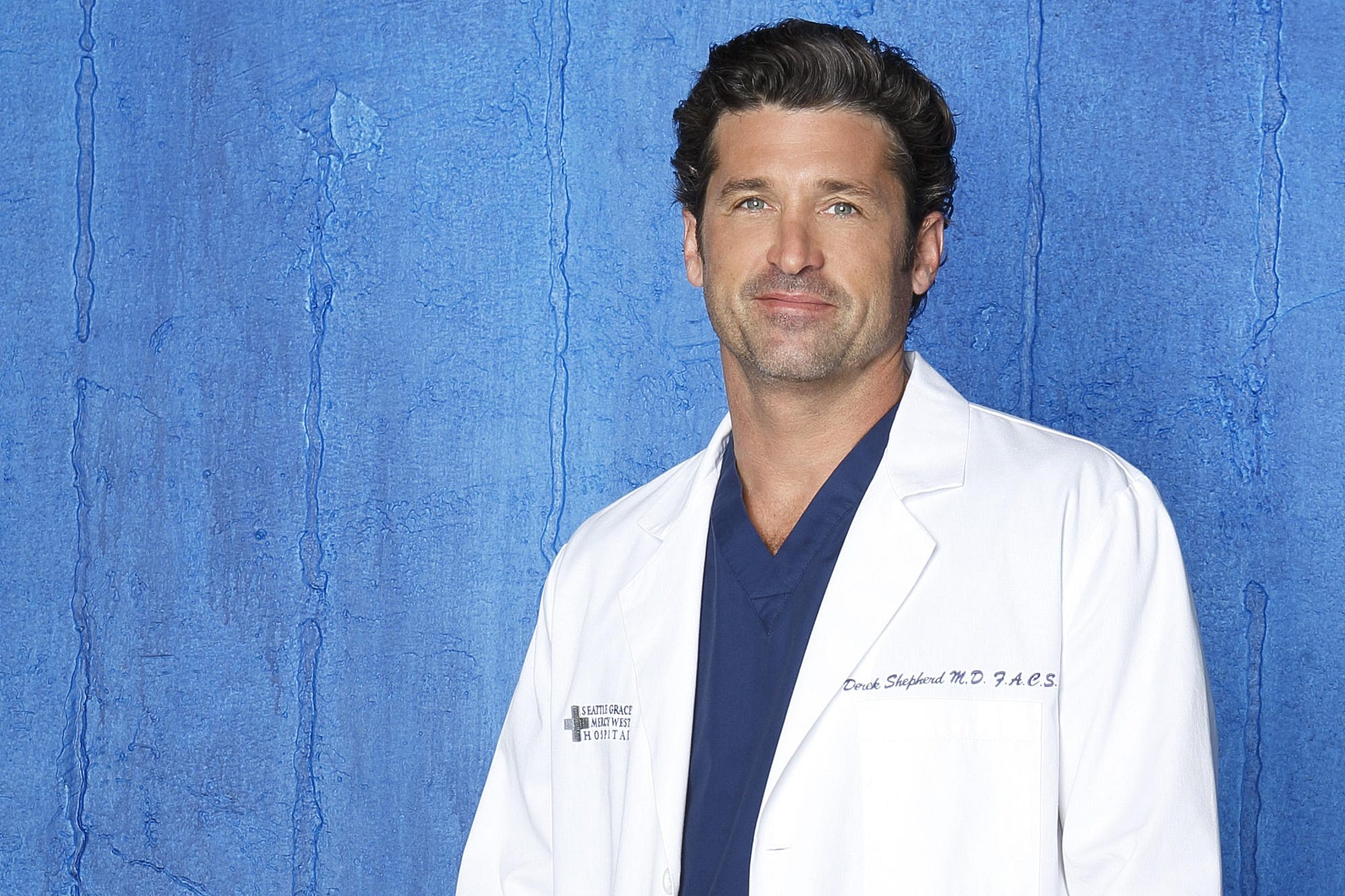
What Derek Shepherd’s Death Says about the U.S. Healthcare System
McDreamy’s death was probably the single most realistic death Grey’s Anatomy has ever shown.
By ABBY NORMAN
I haven’t watched Grey’s Anatomy (2005- ) in more than a year, but when I heard Patrick Dempsey’s character, Derek “McDreamy” Shepherd, had been killed off, I sat down and binge-watched the entire eleventh season.
To date, rumors are still circulating about why, after 11 years on Grey’s Anatomy, Dr. McDreamy is no more:
- Dempsey wanted out of his (just signed) 2-more-year contract because he wanted to pursue other things like producing;
- his “diva behavior” clashed with showrunner, Shonda Rhimes;
- he was fired for having an affair with an intern on-set.
Whatever the reason, Derek Shepherd’s death was a slap in the face to fans. It felt rushed, thrown together, and did absolutely zero justice to his longtime character.
If the second rumor above is true, McDreamy’s death very well might have been intentional (and arguably petty). Rhimes did write this episode, after all — just like she wrote the episode where Lexie (Chyler Leigh) and Mark/McSteamy (Eric Dane) died in that fuckin’ plane crash.
If you haven’t watched yet and don’t plan to, here’s a primer:
The McDreamy Death Episode: A Primer
Derek is a hella good neurosurgeon. Like, hella good. He was driving along minding his own business and ended up witnessing a car accident, where he saved a bunch of lives and befriended an adorably precocious child (played by that kid from Parenthood).
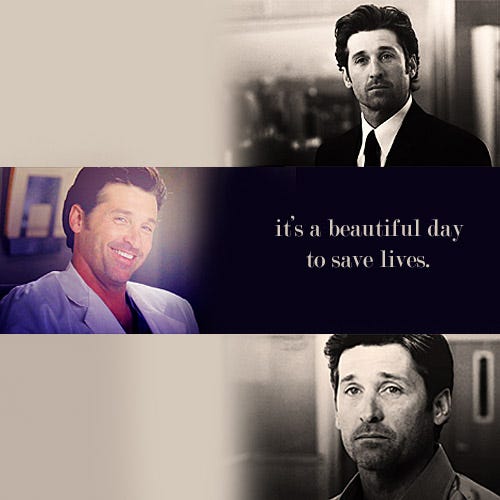
Satisfied with himself, even uttering his gag-worthy catchphrase — It’s a beautiful day to save lives — he hops back into his car and drives onward. Then, he stupidly reaches for his buzzing cellphone.
And gets t-boned by a semi.
But Derek doesn’t die right away. For the next 15 minutes of the show, he’s alive and cognizant. In fact, he gives the us running commentary from the moment he’s brought into some podunk hospital.
Not his hospital. Not the illustrious Grey-Sloan. He’s brought to — well, a normal hospital. A non-trauma center hospital. A hospital probably closer to the one you’d be taken to if you were in a car crash.
And it’s understaffed. And no one is listening to each other. And bad decisions are made. The patriarchal nature of medicine directly contributes to Shepherd’s decline, and he even comments on it in his stream-of-consciousness voiceover: [referring to a male doctor who claims there’s no time for a CT scan] Arrogant… because she’s younger than you and probably because she’s a woman.
Shepherd clearly has a head injury, which he knows because he’s a brain surgeon, and we know because his head is fucking bleeding. The doctors at this general hospital opt to focus on his other injuries and waste valuable time — they do not get any imaging of his brain. They take him into surgery as he silently pleads for them not to.
The one doctor who has it together enough to try to advocate for what he clearly needs is consistently pushed away by her colleagues. Yes, it’s a she — a young she, a I am what Meredith Grey was ten seasons ago she. And when Shepherd gets anesthetized for surgery and crashes, we all get a sinking feeling in the pit of our stomachs that he just died unnecessarily.
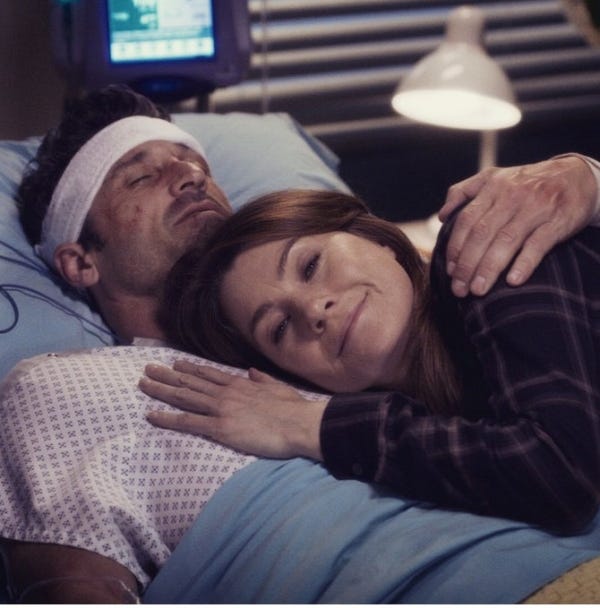
Actually, he didn’t die straight out. He was just brain dead, and by just, I mean with tragic irony: Meredith comes, berates the hospital staff, signs the papers, and lets him go.
She knows the hospital did the best they could, but the truth was, they were not a capable hospital. The doctors were not on top of their shit. They were ill-trained and unempathetic.
And the young doctor who tried, the alternate-universe Meredith Grey, does get a word or two of wisdom from grief-puking Meredith. She tells her that Derek Shepherd will always be “that patient” and that every patient she treats from that day forward will make her a better doctor.
And we have reason to hope that’s true — if that young, smart-as-a-whip girl can just get out of a poorly functioning hospital, the victim of a healthcare system that is dysfunctional at best and, as we saw in this episode, fatal at worst.
RIP: 100,000 Derek Shepherds
I don’t know if Shonda Rhimes intended for Derek Shepherd’s death to be a commentary on the U.S. healthcare system’s inefficiencies, but it certainly could be.
As someone who regularly scoffs at this show’s approach to medicine — which is often whimsical and occasionally wacky — Derek Shepherd’s death, while unjust to fans, was probably the single most realistic death Grey’s Anatomy has ever shown.
In real life, what happened to Shepherd would be called a “sentinel event.” These are deaths that occur that should not have. This is what hospitals call it when a patient dies because someone fucked up big time.
A hospital can lose its operational license for having too many of these in a given year, and each sentinel event is investigated internally and externally by commissions that will evaluate individual and hospital practices that lead to the wrongful death. (I worked in healthcare administration for a time.)
In the next episode of Grey’s, a two-hour special, I’d hoped we get to see some of the aftermath of this sentinel event. And that Meredith would sue. (She didn’t.)
This is why doctors, why hospitals, have malpractice insurance. The Journal of the American Medical Association reported that 250,000 patients die from medical malpractice; nearly half of those deaths occur while the patient is in the hospital.
That’s 100,000 Derek Shepherds.
If you think the devastation that rippled through Twitter after The McDreamy Death Episode aired, imagine the real-life devastation felt by the families of those 100,000, of those 250,000, who die as a result of a sick healthcare system that seemingly doesn’t want to get better.

If you enjoyed this, please hit the green “Recommend” button below so others might also enjoy it.
Follow THE OUTTAKE: Medium | Twitter | Facebook

