


Stonewall: A Gay Movie, But Straight
What’s at stake when Roland Emmerich makes a gay movie for straight people?
Thus far, Roland Emmerich’s historical LGBT-rights film Stonewall (2015) has been one of the year’s most disliked films, even before its premiere at the Toronto International Film Festival.
Having been criticized for white-washing and cis-washing events often considered to mark the moment when the LGBT movement mobilized, the director recently opened up to Buzzfeed about the artistic liberties he took in the film. Aaaaand he kind of made it worse with statements like this: “You have to understand one thing: I didn’t make this movie only for gay people, I made it also for straight people.”
Stonewall’s representational struggles have already been covered elsewhere in great detail, so check out the articles at the bottom of this post for more discussion. In a nutshell, the criticism stems from Emmerich’s choice to cast a fictional cisgender gay man, Danny (Jeremy Irvine), in the central role when historical accounts and activists have suggested a much larger role was played at the riots by queer people of color, butch dykes, drag queens, and trans women.
Others argue there is no way to tell who threw the first brick, and the debates occurring across identities are somewhat of a derailing of the actual issues at hand. Professor Susan Stryker, for instance, suggests that “Fighting over Stonewall history is a proxy battle for more entrenched structural conflicts.”
While white gay men were doubtless present at the riots, the centering of such a character in Stonewall (coupled with the marginalization of people of color and gender non-normative identities in the film) is significant and speaks volumes about LGBT rights as they are now, even though they are framed retrospectively by the lens of historical narrative. We can also position the film within contemporary Hollywood practices, especially relating to Emmerich himself.
Of the myriad identities to be found under the LGBT umbrella, white gay men have definitely witnessed the greatest amount of upward mobility since the movement started. White gay men are the posterboys for a movement which encompasses all forms of queerness, at least in theory.
The past few years have seen a steady increase in the visibility of white gay men in the media. GLAAD’s annual report of LGBT media representation last year found that out of 65 LGBT regular and recurring characters in primetime scripted shows, 54 percent were gay men (up from 46 percent the previous year). Meanwhile out of those 65 characters, 74 percent are white, suggesting that there is indeed a crossover between these identities. As loving parents in (also debated) shows such as Modern Family (2009 — ) and The New Normal (2012–13), the “normalized” image of white gay men speaks to an ideology which privileges the heterosexual nuclear family unit — albeit a “gay version.”
These narratives of assimilation are the result of what Suzanna Walters refers to as the “tolerance trap.” The tolerance trap is a kind of trick that’s being played on LGBT people in Western culture, in which ideas of acceptance, tolerance, and integration are promoted. But acceptance is a loaded term, as is tolerance. We tolerate annoyances. We tolerate things that are bad. We might tolerate mosquitoes or the flu virus. LGBT people aren’t flu viruses though, so the idea of acceptance is basically a vessel through which narratives of assimilation can occur. It suggests that LGBT people should strive to fit into a world which is unchangeably straight.
And that’s the point where we get cis gay men as centrepieces of LGBT-rights narratives. In representational terms, they signify the least offensive, most easily tolerable form of queerness.
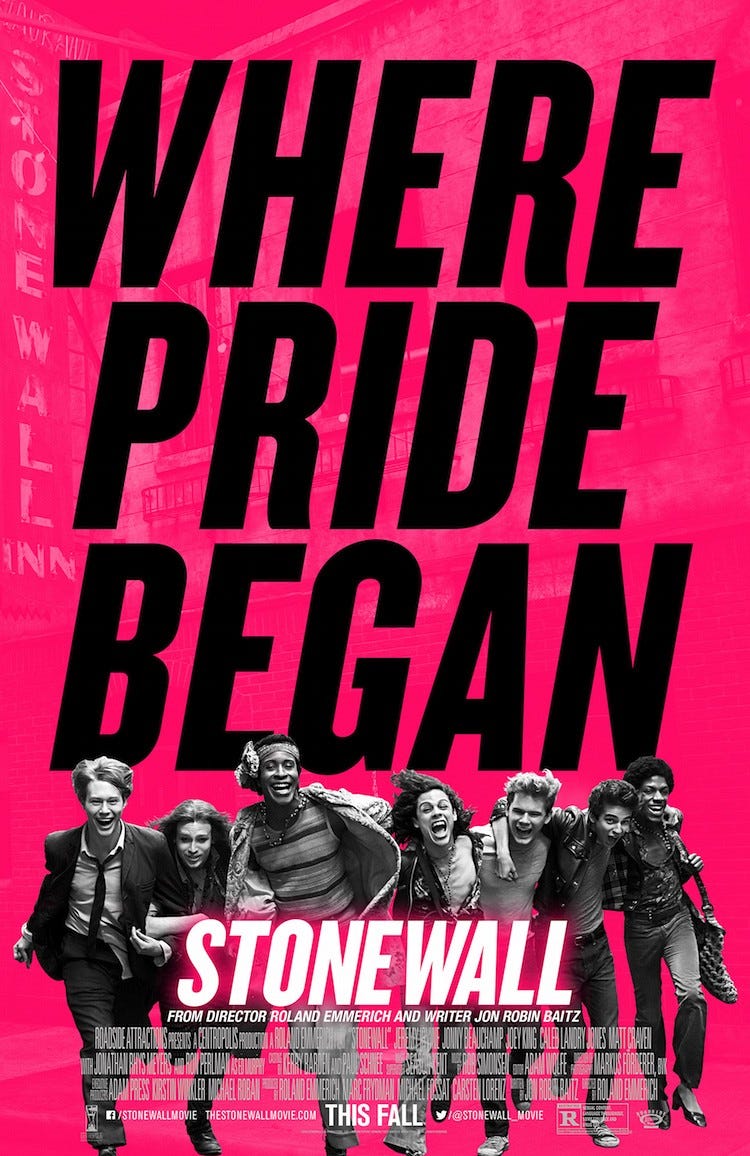
Again, in his interview with Buzzfeed, Stonewall’s director pretty much admitted to saying that he wanted the central character — Danny — to fit right in to heterosexual values.
“‘You have to understand one thing: I didn’t make this movie only for gay people, I made it also for straight people,’ he said. ‘I kind of found out, in the testing process, that actually, for straight people, [Danny] is a very easy in. Danny’s very straight-acting. He gets mistreated because of that. [Straight audiences] can feel for him.’”
The concept of “straight-acting” queers crops up time and again in discussions of LGBT rights. Straight-acting is often considered a good thing because it allows LGBT people to get by without the drama of flamboyantly drawing attention to themselves and their silly human rights issues (you know how those gays can be!). Straight-acting is convenient for straight people because it means not having to deal with difference. It means “acceptance.” Most importantly, it means assimilation.
And when LGBT people refer to straight-acting in positive terms, it gets even more complicated. In the words of alto, it’s a term by which a gay man can say “I’m not one of those fags.” Because gay men are stereotypically effeminate, sissy, and soft and those aren’t things that “real” men want to be… By extension, this is the result of devaluing cultural notions of femininity — and here we arrive at the intersection between gender and sexuality once again.
Later in his Buzzfeed interview, Emmerich further justifies the inclusion of Danny as the film’s protagonist as being a representation of himself. Taking a “personal” approach, he notes, “As a director you have to put yourself in your movies, and I’m white and gay.” Well, obviously it’s easy for Emmerich to put someone like himself in the movie because that’s the most culturally acceptable image queerness we’ve got. But this viewpoint is also troubling because of the way in which it centers the “me” in collective struggles.

Quite often we have narratives of people who didn’t care for a political cause until it somehow affected them personally. It’s a bit like when a thin person wears a fat suit to “experience obesity.” Oh right, after this harrowing experience of putting on a fat suit for a day and then taking it off, now you care what it’s like to be socially outcast. Or it’s like when straight people change their minds about homosexuality after discovering a family member is gay, or maybe seeing a pretty white gay guy in a movie. You know, someone just like us, ordinary people, who are white.
Roland Emmerich is a powerhouse director, most famous for having made films such as Independence Day (1996) and The Day After Tomorrow (2004). He’s often talked about his multi-national, collective approach to identity in his films. For a German director, it’s noteworthy that his films feel like distinctly American, Hollywood movies. A lot of times, it’s America that saves the day, but as a filmmaker he’s been very keen on the idea of “global appeal,” incorporating representations of people of different genders, races and sexualities, but inevitably recentering the straight white male hero. This contradictory standpoint has been discussed by Christine Haase from a more academic perspective. She says,
“The clichéd but superficially politically correct representations of gender, race, and nationality in Emmerich’s movies and their flipside of sexist, racist, and jingoistic subtexts indicate once more the director’s opportunism in appealing to the widest possible range of spectators, this is, to one segment of the public by acknowledging its particular set of values and to another by repudiating those same values.”
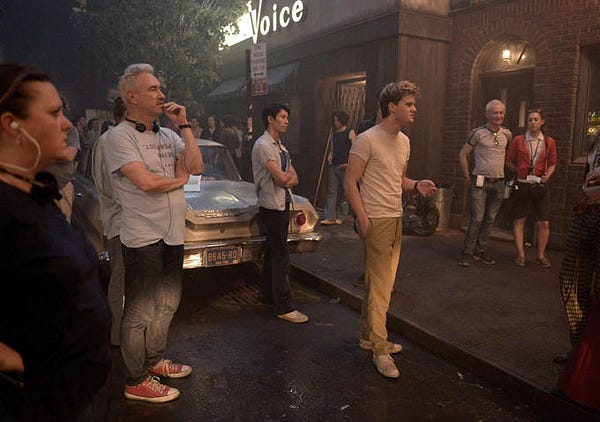
What this means in relation to Stonewall is that Emmerich wants to appeal to a large audience — all the people, everywhere — but he does this through representations which are kind of in opposition to each other. He wants to appeal to LGBT people, so he makes a film about LGBT people. He wants to appeal to straight people, so he makes it about the most acceptable version of queerness that he could possibly find. He makes it about him.
With Stonewall, Emmerich acknowledges the values of LGBT people, but in order to appeal to straight people he needs to make it less radical, less queer. So it’s likely that his “all inclusive” approach may have informed his desire to make a movie “for the people,” only that “the people” defaults to “straight people” in his eyes. And that’s a problem.
But as I said, Emmerich is a powerhouse director. Imagine the resources at his disposal. Imagine what a director of his caliber could have done if he wasn’t fixated on straight audiences and himself? What would a high-profile gay movie for gays even look like? It shouldn’t really be the responsibility of the director to teach heterosexuals what it means to be gay. To quote Audre Lourde:
“Black and Third World people are expected to educate white people as to our humanity. Women are expected to educate men. Lesbians and gay men are expected to educate the heterosexual world. The oppressors maintain their position and evade responsibility for their own actions. There is a constant drain of energy which might be better used in redefining ourselves and devising realistic scenarios for altering the present and constructing the future.”
Further Reading
“GLAAD’s Where We Are on TV Report 2014.” 2014. GLAAD.
Haase, Christine. 2007. When Heimat Meets Hollywood: German Filmmakers and America, 1985–2005. New York: Camden House.
Jusino, Teresa. 2015. “Stonewall: A Film About a Historic Moment of Resistance…That Erases the People Who Were There.” The Mary Sue, July 1.
Keating, Shannon. 2015. “Director Roland Emmerich Discusses ‘Stonewall’ Controversy.” Buzzfeed, September 22.
Londoño, Ernesto. 2015. “Who Threw the First Brick at Stonewall?” The New York Times, August 26.
Lourde, Audre. 1984. “Age, Race, Class and Sex: Women Redefining Difference,” in Sister Outsider: Essays and Speeches. Freedom, CA: Crossing Press, pp. 114–123.
Taylor, Trey. 2015. “Will new film Stonewall be another example of whitewashing?” Dazed, August 6.
Walters, Suzanna Danuta. 2014. The Tolerance Trap: How God, Genes, and Good Intentions are Sabotaging Gay Equality. New York: NYU Press.

If you enjoyed this, please hit the green “Recommend” button below so others might also enjoy it.
Medium | Twitter | Facebook

